
The season is long
Cooling runs from April into October. That is well beyond the national average in operating hours per year.
Home/Seasonal Maintenance
Most of the emergency calls we run in July trace back to something a spring inspection would have caught in April. Two checks a year is the cheapest thing you can do for a system in this climate.
North Texas is harder on equipment than most of the country, and the maintenance interval should reflect that.
Cooling runs from April into October. That is well beyond the national average in operating hours per year.
Capacitors, contactors, and motors degrade faster under sustained high ambient temperatures than under mild ones.
Cottonwood, grass clippings, and dust pack condenser coils and choke heat transfer within a single season.
Humidity plus warmth grows algae in condensate lines. A backed-up drain floods a pan and then a ceiling.
Equipment breaks when it works hardest, which is exactly when everyone is booked and nobody wants to wait.
A pitted contactor caught in spring is a minor repair. The same part failing in August is an emergency call.
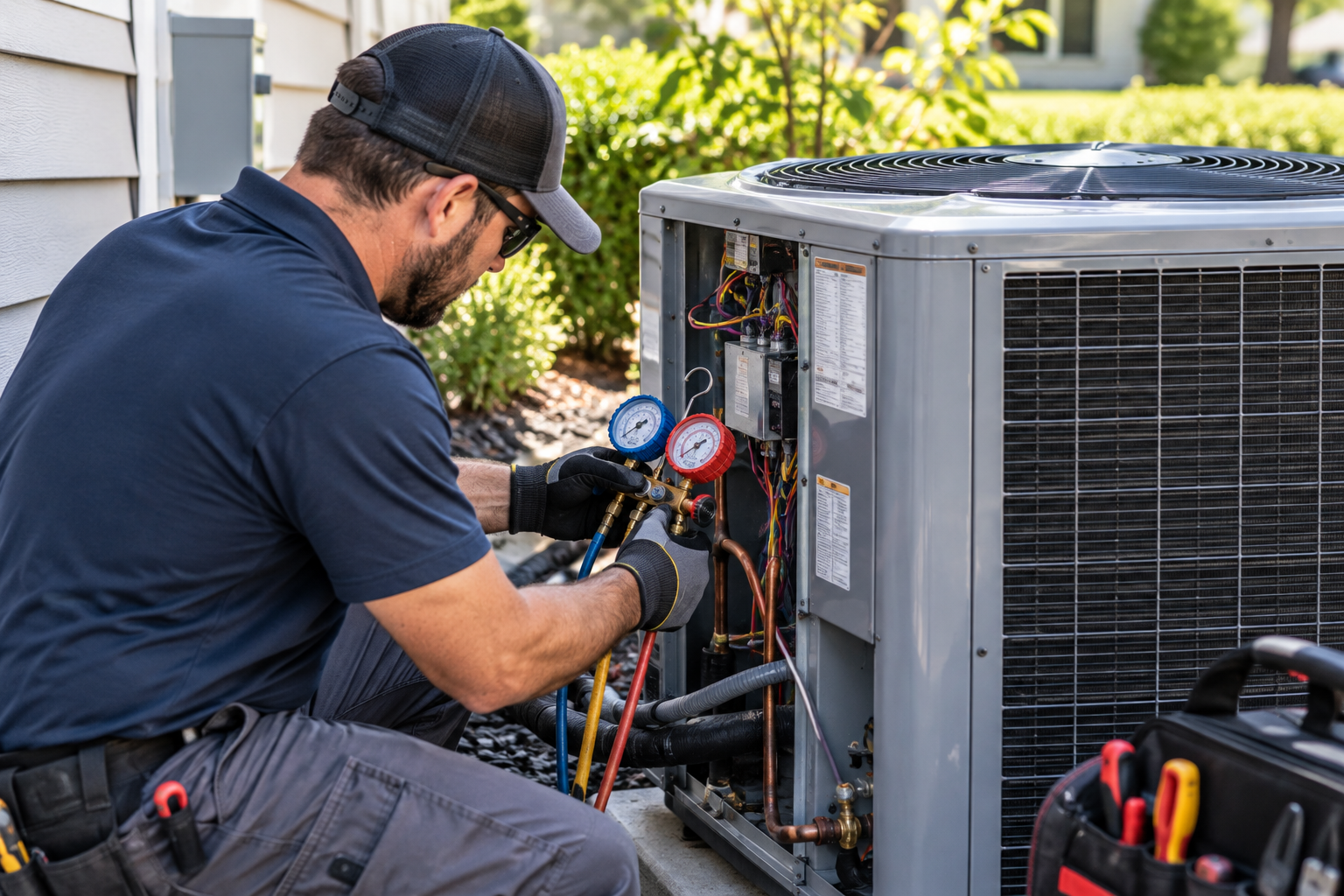
The two visits look at different things, and both matter. The spring visit is about making sure the system can survive the summer at full load: refrigerant charge, coil condition, electrical components under stress, and the condensate drain that will run constantly for the next six months.
The fall visit shifts to combustion and safety. Ignition sequence, heat exchanger condition, venting, and the safety switches that shut the gas off when something is not right. It is also the visit where a heat pump's reversing valve and defrost function get verified before the first cold night rather than during it.
Neither visit is long, and neither is a sales appointment. If everything checks out we tell you it checks out.
The specifics vary between the cooling and heating visits, but the scope covers these areas.
Coils cleaned and inspected. Condenser and evaporator, since restricted heat transfer drives both bills and failures.
Refrigerant charge verified. Pressures and temperature split measured against what the system should be producing.
Electrical components tested. Capacitors measured under load, contactors inspected for pitting, connections tightened.
Condensate drain cleared. Line flushed and the pan checked, which prevents the most common water damage claim we see.
Combustion and safety. On the fall visit: ignition sequence, flame sensor, heat exchanger, venting, and limit switches.
Airflow and filtration. Filter condition, blower operation, and obvious duct problems noted with what they are costing you.
Book ahead of the season rather than during it — spring and fall fill up fast.
Spring for cooling, fall for heating. Booking before the rush means you pick the day.
Both the indoor and outdoor equipment, measured rather than glanced at.
What is fine, what is wearing, and what should be addressed before the season loads it up.
Anything found gets priced before it gets fixed, and nothing gets fixed without your say-so.
Everything we handle for homeowners across the Dallas–Fort Worth area.
Diagnosis and repair for systems blowing warm, running constantly, or not starting.
Gas furnaces, heat pumps, and electric heat when the house will not warm up.
Properly sized replacements when repair no longer makes financial sense.
Filtration, duct sealing, and humidity control for dusty or uneven homes.
Serving Ellis County, southern Dallas County, and the surrounding Dallas–Fort Worth metroplex.
We also serve Mansfield in Tarrant County, Venus and Alvarado in Johnson County, and Corsicana in Navarro County. Just outside the list? Give us a call at (214) 730-3063.
A spring cooling check or fall heating check before the weather turns is the easiest call you will make all year.
Monday–Friday 8:00am–5:00pm · After-hours emergency service available